

| Created: 2025-12-27 07:03:46 Last Edited: 2026-01-17 16:24:24 | |
| Submitted by: PhoenixBlue ☀ on behalf of Zoink | |
| Star System: | LGM-1 |
| Coordinates: | -7533.47 / 557.344 / 5124.12 |
| Sol Distance: | 9,128 ly |
| Region: | Inner Orion Spur |
| Category: | Historical |
|
| |
 | |
Summary: LGM-1 was the first pulsar discovered by astronomers at Cambridge University in 1967. | |
Notice: This POI shares the same star system with a prior existing entry in the Galactic Mapping Project (GMP). You can visit the original entry using the link below: | |
Description: LGM-1, formally catalogued as PSR B1919+21, is the first-discovered neutron star. Dame Jocelyn Bell Burnell, a graduate student at Cambridge University, found a strong regular signal in the radio spectrum that had a period of about 1.3 seconds during her work at Cambridge in 1967. Burnell labeled the discovery "little green men 1," giving to the remote possibility that the signal was not naturally occurring, but an artificial beacon instead. Following up on her discovery, Bell Burnell later found a similar repeating radio signal in a different sector of the galaxy. The second discovery, she said in a 21st century television interview, "scotched the little green men hypothesis ... Because it's highly unlikely there's two lots of little green men, on opposite sides of the universe, both deciding to signal to a rather inconspicuous planet, Earth, at the same time, using a daft technique and a rather commonplace frequency." Bell Burnell branched out into gamma ray, x-ray and infrared astronomy in her professional career. She received a British knighthood in 2007 for her astrophysics research and was named a Companion of Honour for her services to astronomy, physics and diversity.
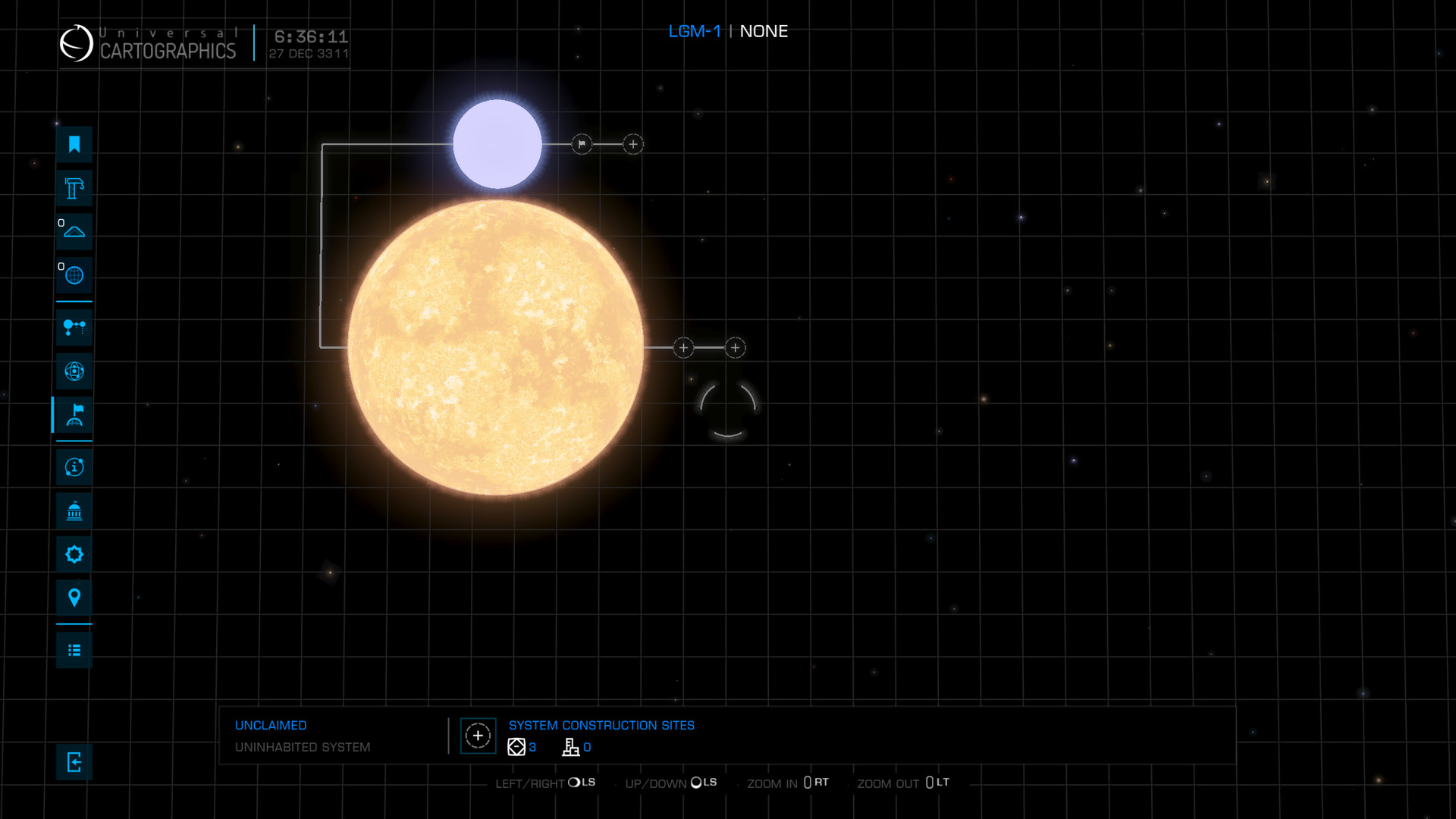
The first human to visit LGM-1 and return with the system cartographics data was CMDR Zoink. When he did, he found that the neutron star's rotation had slowed from 1.377 seconds to 1.512 seconds. Most of this discrepancy arises from the 9,000 light-years separating LGM-1 from the Core Systems, which meant measurements taken from Earth were 9,000 years out-of-date. Over those millennia, starquakes gradually decreased the neutron star's rotational period by 0.135 seconds, or about 10 percent of its speed as first measured by Bell Burnell. However, according to Universal Cartographics databanks, the star's rotational period is an astonishing 36.18 seconds. Scientists have chalked this up to a math error, as it deviates from the star's true rotation speed by a factor of exactly 24. The pulsar and its companion, a G-class main sequence star, are about 1.77 billion years old. LGM-1 has 1.40 solar masses, placing it near the lower bound of neutron star masses; its radius is 8.9 km, making it four times the size of Cambridge or about as large as the District of Columbia. Its companion star is about 0.91 solar masses and 0.96 solar radii. The two stars orbit their common barycentre once every 7,152 years. The system lies about 600 light-years from the Traikeou AA-A h2 nebula, making it a potential side trip for anyone visiting the nebula on their way to the Milky Way's Temple region. | |
| ID64 Address: | 8900430699 |
| EDSM ID: | 677507 |
EDSM Traffic Report
| Past Day: | |
| Past Week: | |
| Total: |
EDSM Estimated Value
| Scanned: | |
| Mapped: |
Nearest GEC Neighbors:
| POI Name | Distance | Rating | System |
|---|---|---|---|
| Traikeou AA‑A h2 Nebula (B... | 587.60 | 5.82 | Traikeou BP‑F b28‑0 |
| Shepherd’s Haven | 944.85 | 4.07 | Gru Drye LX‑A d1‑41 |
| Mordor Ice Rally Circuit | 1,001.02 | 5.17 | Traikeou KB‑X b18‑0 |
| Traikeou Goliaths | 1,271.06 | 2.89 | Traikeou AA‑A h4 |
| Michellins Stars | 1,389.16 | 1.36 | Smojeia CH‑B d14‑4 |
| A Mercurial Circumnavigation | 1,969.46 | 3.88 | Smojeia LI‑E c14‑1 |
| Jade Green Pentagon | 2,599.19 | 6.64 | Lysoovsky BH‑L d8‑26 |
| Evaporating Giant | 3,248.43 | 2.59 | Thailoea TE‑V c4‑1 |
Nearest GMP Neighbors:
| POI Name | Distance | Rating | System |
|---|---|---|---|
| LGM‑1 Pulsar | 0.01 | N/A | Lgm‑1 |
| Traikeou Nebula | 615.68 | N/A | Traikeou KO‑E c13‑1 |
| The Traikeou Wolf‑Rayet | 708.59 | N/A | Traikeou AA‑A h0 |
| Goliath's Rest Stop | 1,130.71 | N/A | Traikeou OR‑W b5‑0 |
| The Traikeou Goliaths | 1,271.06 | N/A | Traikeou AA‑A h4 |
| QZ Vulpeculae | 1,594.68 | N/A | QZ Vulpeculae |
| Existence in Desolation | 1,663.26 | N/A | Thailoe UO‑A e4 |
| NGC 6886 | 1,899.56 | N/A | Csi+19‑20105 |
Revision History: